Some links on this page are affiliate links. If you buy through one, I may earn a small commission at no extra cost to you. Nothing here is sponsored and no brand paid to be included.
You have sensitive skin, so you reach for the bottle that says hypoallergenic. It feels like the safe choice. It is the word people trust most on a skin care label.
It is also the word that tells you the least. Here is what it really means, what to look for instead, and how to stop paying extra for a promise nobody has to keep.
Does hypoallergenic mean allergy free?
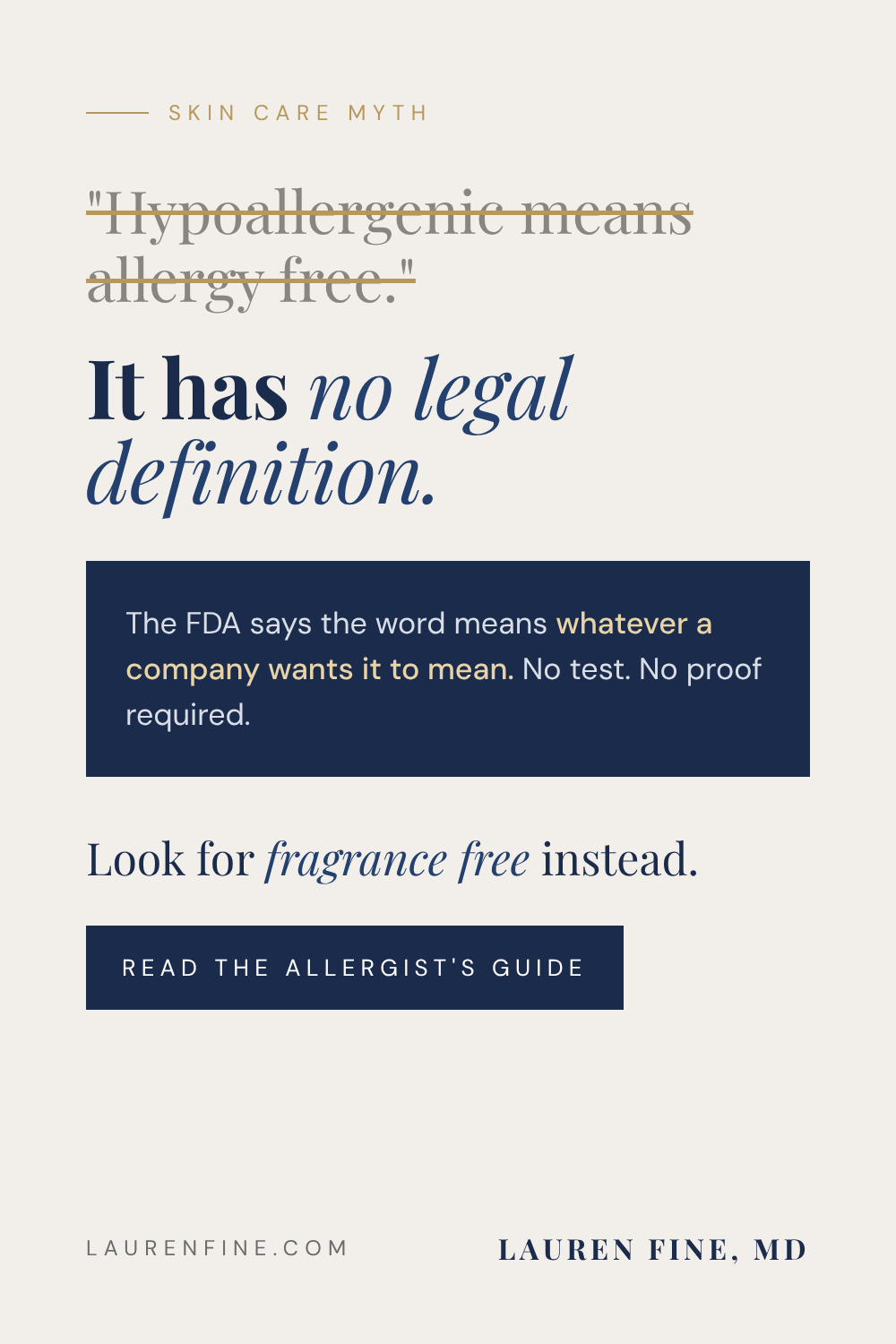
No. In the United States, there are no federal standards or definitions for the word hypoallergenic. The FDA says it means whatever a particular company wants it to mean. No company has to test for it or prove it.
The FDA did try to define it in the 1970s. Cosmetic companies challenged the rule in court, and the court threw it out. Nothing has replaced it since.
What researchers found inside "hypoallergenic" products
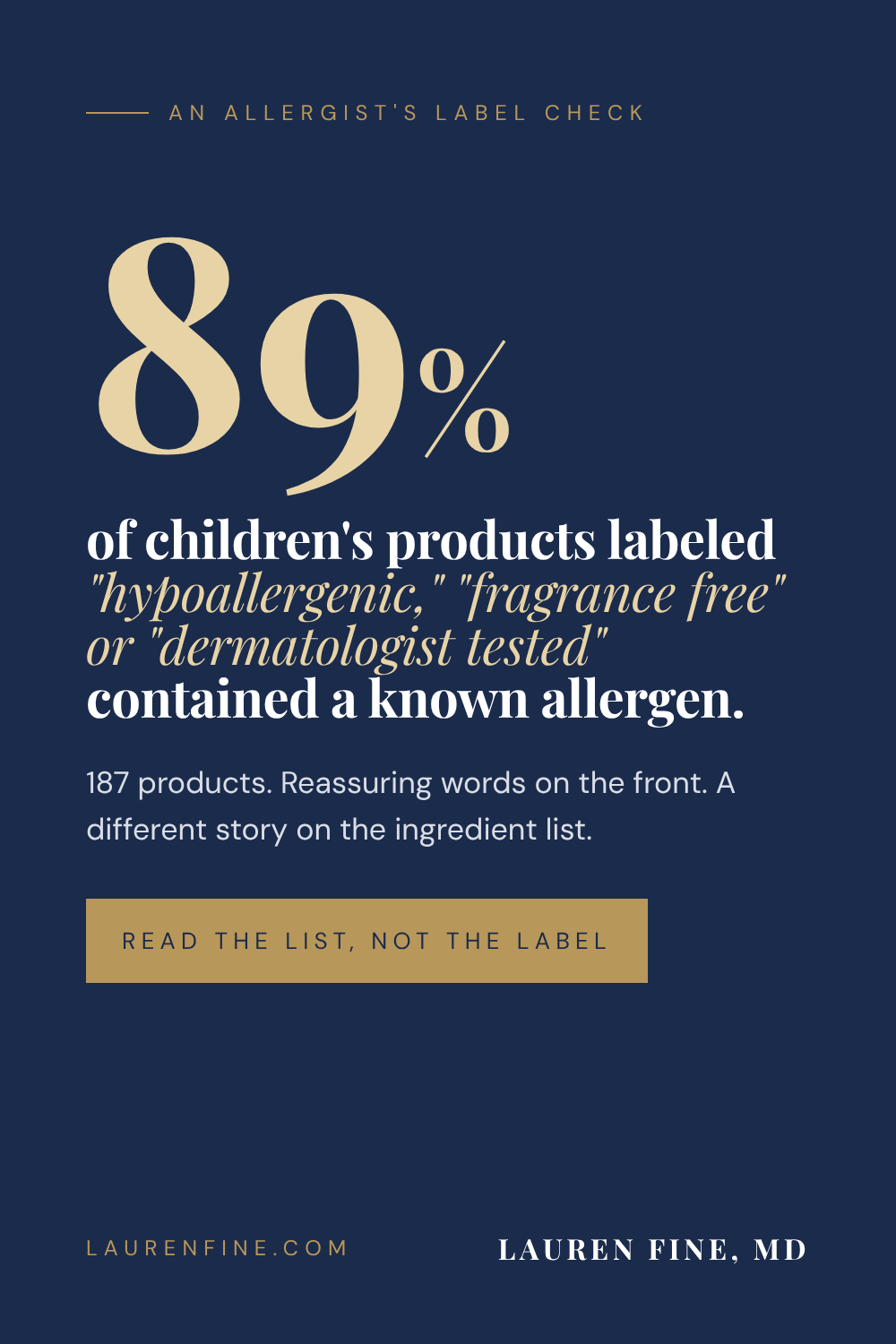
In one study, researchers looked at 187 children's skin care products sold in the United States with labels like hypoallergenic, dermatologist tested or fragrance free. 89 percent contained at least one known contact allergen. Many contained two or more.
Those were products made for children, with reassuring words on the front. The label did not match the list on the back.
The skin care label decoder
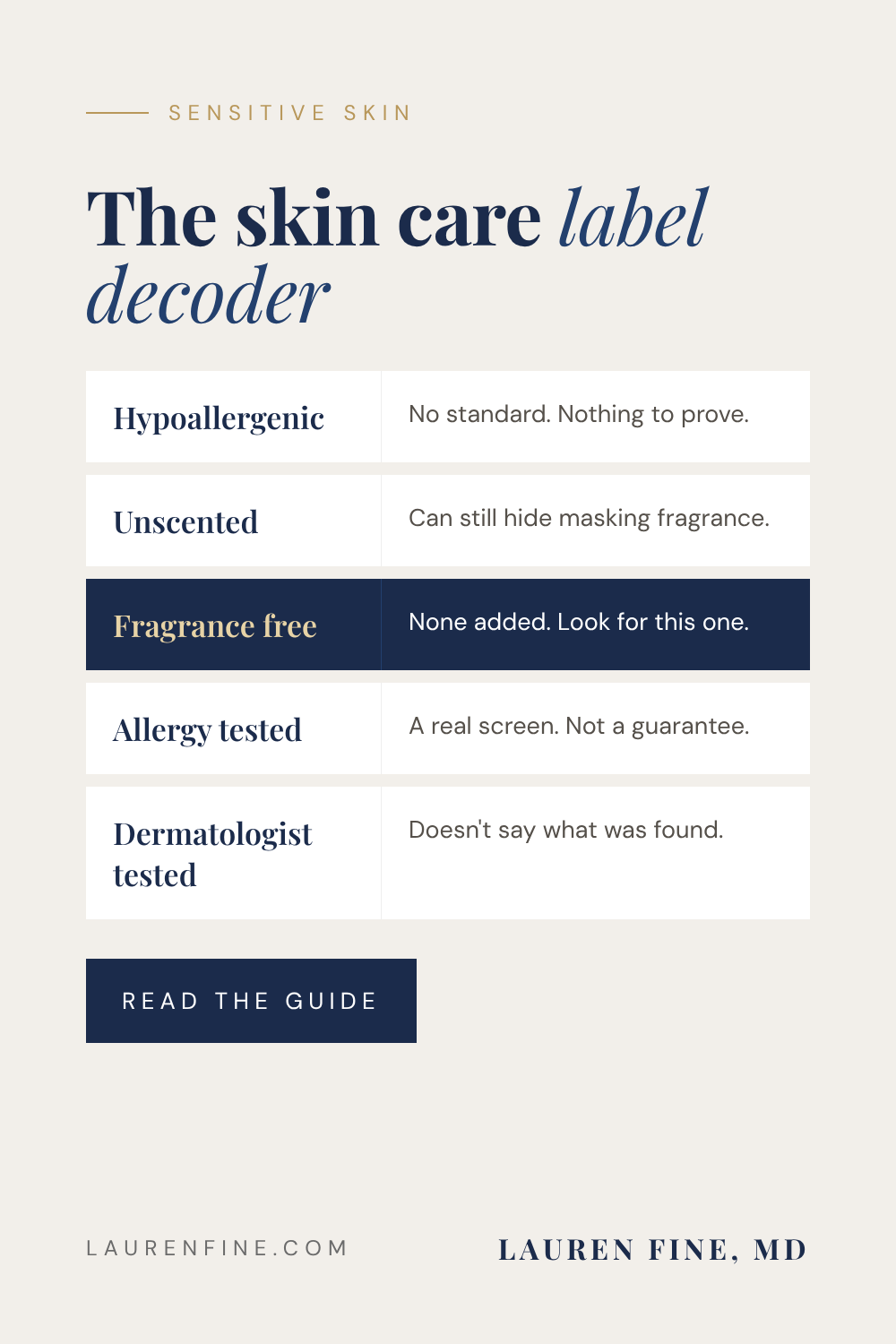
| On the label | What it really means |
|---|---|
| Hypoallergenic | Nothing that has to be proven. No standard, no required test. |
| Unscented | It may still contain fragrance, added to mask the smell of other ingredients. |
| Fragrance free | No fragrance was added. You can check it on the ingredient list. This is the one to look for. |
| Allergy tested | A real screening test, with real limits. See below. |
| Dermatologist tested | A dermatologist was involved somewhere. It does not say how, or what was found. |
What "allergy tested" really means
The test behind "allergy tested" is usually a repeated patch test on about 100 to 200 volunteers. Patches go on the back nine times over three weeks. After a two-week rest, a new patch goes on fresh skin to see whether the immune system has learned to react.
That is a real test, and it catches strong allergens before a product ships. But a panel of about 100 people cannot catch a reaction that affects fewer than about 1 in 100 users. Allergy tested is a screen, not a promise.
The ingredient that matters most: fragrance
Under US labeling rules, an entire fragrance blend can appear on the ingredient list as one word: fragrance. The formula is a trade secret. On a scented product, you have no way to know what you are putting on your skin.
That matters because fragrance chemicals are among the most common allergens found in patch testing. In the most recent North American Contact Dermatitis Group report, 3,056 patients were patch tested. One oxidized fragrance ingredient, hydroperoxides of linalool, was positive in 10.1 percent of them.
If you change one thing, make it this. Choose fragrance free.
How to shop for sensitive skin
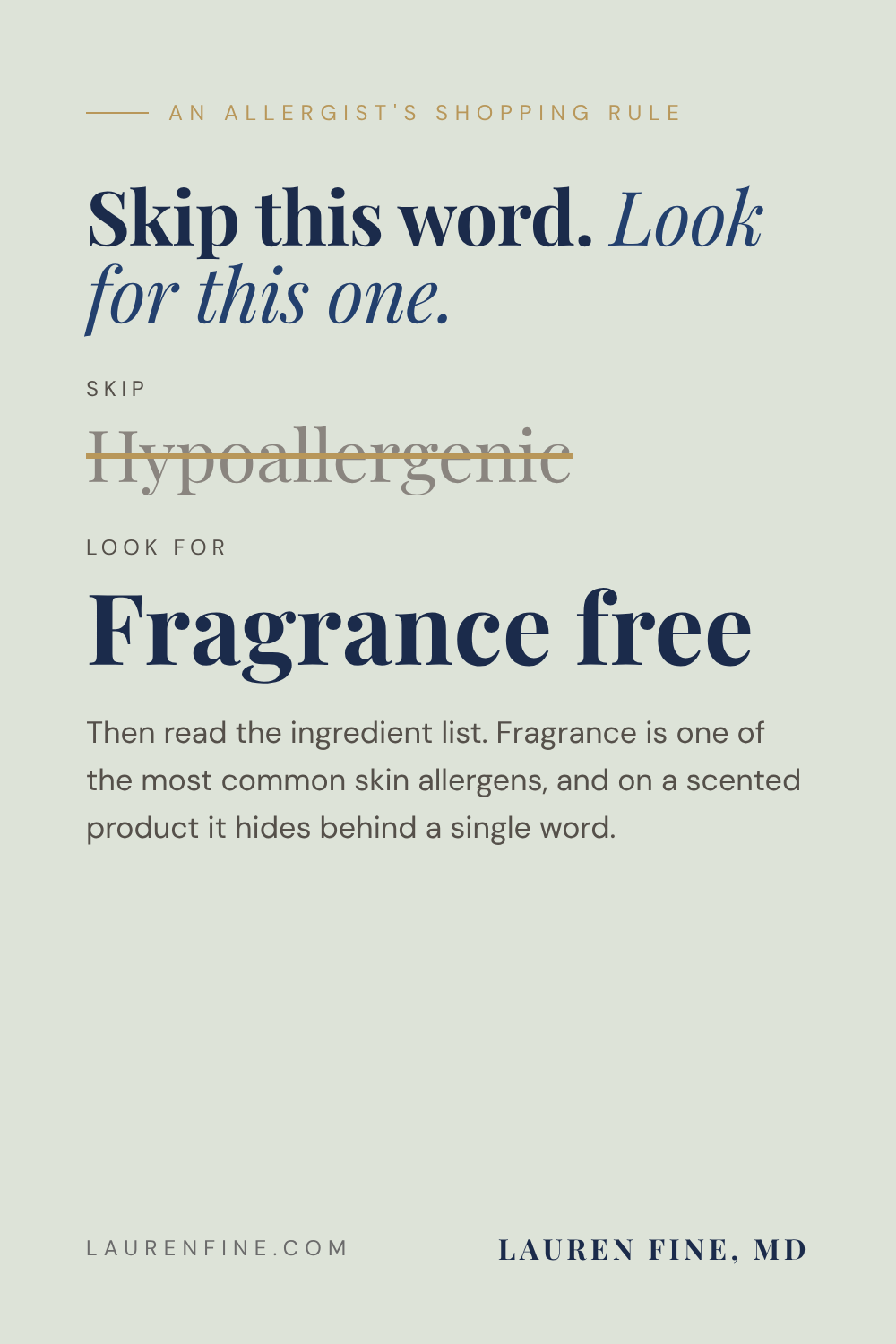
- Ignore the word hypoallergenic. It is not a reason to buy and not a reason to pay more.
- Look for fragrance free, not unscented.
- Read the ingredient list. Fewer ingredients means fewer chances to react.
- Treat allergy tested as a plus, not a guarantee.
- Try one new product at a time. If you react, you will know which one it was.
- Don't assume expensive means gentle. Some of the simplest fragrance-free products are drugstore brands.
Sensitive skin products I recommend
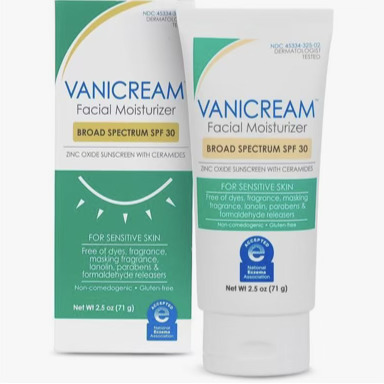
Vanicream
Vanicream Facial Moisturizer SPF 30
Free of dyes, fragrance, lanolin, parabens and formaldehyde releasers, the ingredients most often flagged in patch testing. It is the one I recommend to patients with sensitive skin.
Shop Vanicream SPF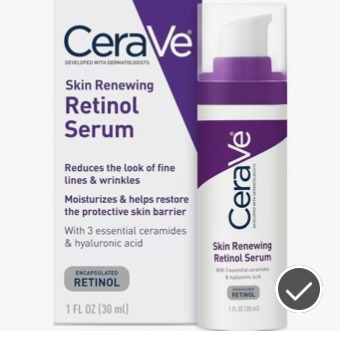
CeraVe
CeraVe Skin Renewing Retinol Serum
Fragrance free, with an encapsulated retinol that releases slowly, plus niacinamide and ceramides to reduce redness and flaking. Start two to three nights a week.
Shop CeraVe Retinol Serum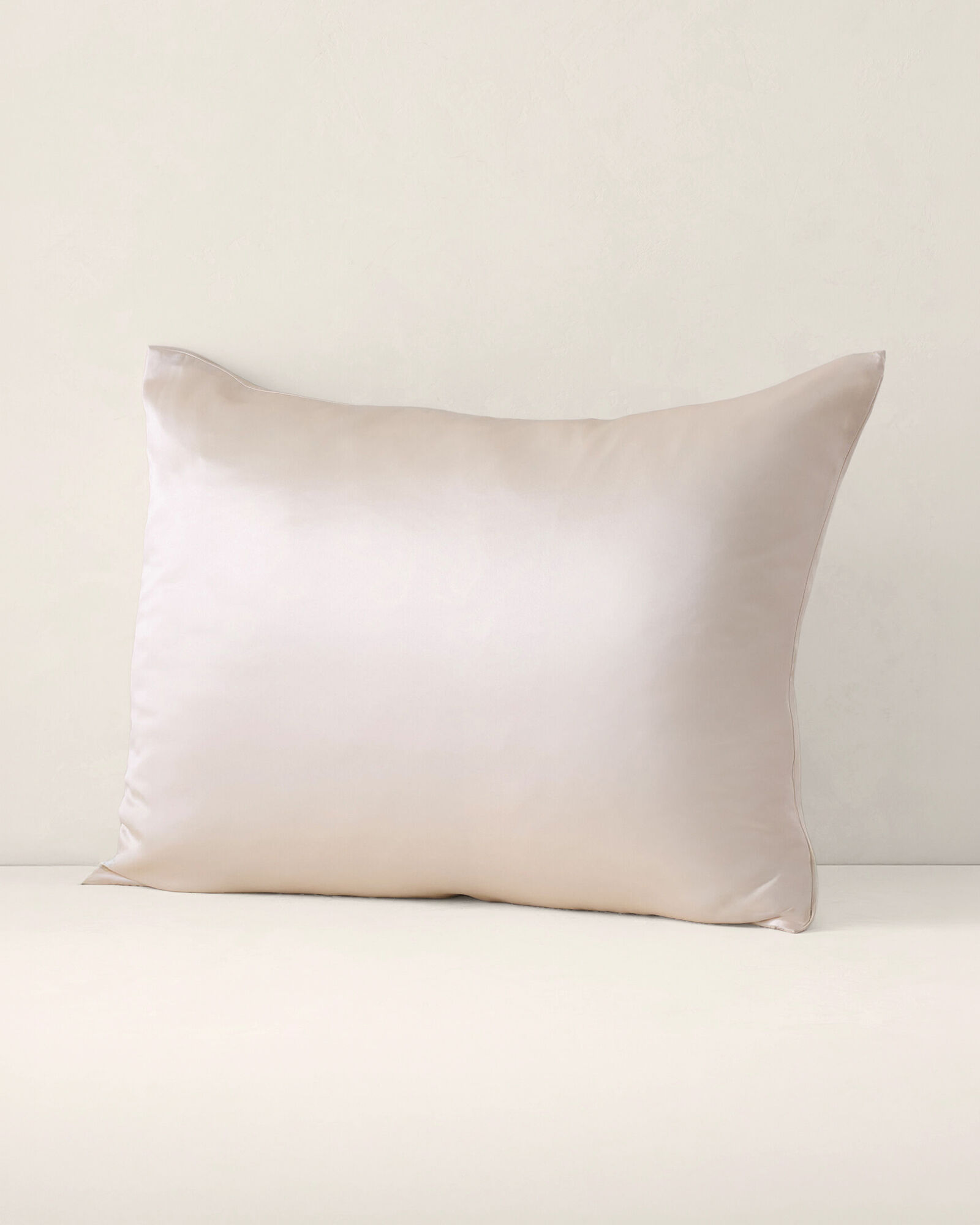
Haven Well Within
Washable Silk Pillowcase
Your face rests on it for hours. This one goes in the washing machine, so it actually gets washed.
Shop the pillowcaseSee everything I recommend for sensitive skin and an allergy-friendly home on my recommendations page. If dust mites are part of your problem, start with the allergist's bedroom checklist.
When a label can't help you
If your skin keeps reacting and you don't know why, no label will answer that. Patch testing by an allergist or dermatologist can identify the exact ingredients your skin reacts to. Then you know what to avoid, instead of guessing.
Make room
Sensitive skin is one more thing to manage in a full life. You don't need a 10-step routine or the most expensive bottle on the shelf. Skip the word hypoallergenic. Look for fragrance free. Read the list. That is the whole system.
This article is general information, not medical advice. If you have a rash that is spreading, blistering, or not improving, see your doctor.
Frequently asked questions
Does hypoallergenic mean allergy free?
No. In the United States there is no federal standard or definition for "hypoallergenic." The FDA says the word means whatever a company wants it to mean, and no company has to prove it.
Is hypoallergenic good for sensitive skin?
The word alone tells you very little. Look for "fragrance free" and check the ingredient list instead. Fragrance is one of the most common causes of allergic skin reactions.
What is the difference between unscented and fragrance free?
Fragrance free means no fragrance was added. Unscented can still contain fragrance chemicals added to mask the smell of other ingredients. If you react to fragrance, choose fragrance free.
What does allergy tested mean on skin care?
It usually means the product went through a repeated patch test on about 100 to 200 volunteers. That screens out strong allergens, but it cannot promise that no one will react.
How do I find out what my skin is allergic to?
Patch testing by an allergist or dermatologist is the way to identify the specific ingredients your skin reacts to. No label can do that for you.
Sources: FDA, "Hypoallergenic" Cosmetics; FDA, Fragrances in Cosmetics; Hamann et al., Journal of Allergy and Clinical Immunology, 2015; North American Contact Dermatitis Group, 2021-2022; Basketter, Cutaneous and Ocular Toxicology, 2009.