Most people think of a boundary as one thing. Saying no. In practice, boundaries come in types. You can be firm about your money and have no limits at all on your time. Knowing the type tells you where the leak is.
Lists vary. Some name three types, some five, some seven. Here are the seven that come up most, with an example and a one-line script for each.
The 7 types of boundaries
1. Physical boundaries
Your body, your personal space, your privacy and your rest.
Examples:
- Saying you prefer a handshake to a hug.
- Closing the door when you need twenty minutes alone.
- Leaving when you are tired instead of staying to be polite.
Try saying: “I’m not a hugger. A handshake is great.”
2. Emotional boundaries
What feelings you take on, and what you share. You can care about someone without carrying their emotions for them.
Examples:
- Not being the family’s on-call therapist.
- Choosing not to share something personal at work.
- Ending a conversation that turns into blame.
Try saying: “I want to help. I can talk for ten minutes tonight, then I need to switch off.”
3. Time boundaries
How your hours are spent. For high achievers, this is usually the boundary that matters most, and the one that leaks first.
Examples:
- No meetings before 9 a.m.
- One protected family block each week.
- Asking for a day before you commit to anything new.
Try saying: “I don’t take calls after 7 p.m. I’ll get back to you first thing tomorrow.”
4. Mental boundaries
Your thoughts, opinions and beliefs. You can hear someone out without debating, and you can disagree without explaining.
Examples:
- Declining to argue politics at the dinner table.
- Holding your opinion when someone pushes for agreement.
- Not taking on someone else’s view of your choices.
Try saying: “I see it differently, and I’m not going to debate it today.”
5. Material and financial boundaries
Your money and your things. What you lend, what you share and what you pay for.
Examples:
- Not lending money you cannot afford to lose.
- Saying no to splitting a bill you did not run up.
- Deciding which belongings are not for borrowing.
Try saying: “I’m not able to lend money. I’m happy to help you think through a plan.”
6. Digital boundaries
Your phone, your messages and your online life. Being reachable is not the same as being available.
Examples:
- Checking messages twice a day instead of all day.
- Turning off work notifications on weekends.
- Not sharing passwords or your location by default.
Try saying: “I check messages twice a day. If it’s urgent, please call.”
7. Sexual boundaries
Consent, comfort and what you are and are not willing to do. These are not up for negotiation.
Examples:
- Saying no, at any point.
- Speaking up about what you are comfortable with.
- Leaving a situation that does not feel right.
Try saying: “No.” It is a complete sentence. If someone is pressuring or hurting you, that is a safety issue, not a boundary-setting problem. Reach out to a professional you trust.
Porous, rigid and healthy boundaries
Every type of boundary can be too loose, too tight or about right.
- Porous boundaries let almost everything through. You say yes before the question is finished. You take on other people’s problems as your own.
- Rigid boundaries keep everyone out. You never ask for help. You keep people at a distance so no one can ask anything of you.
- Healthy boundaries are firm and flexible. You decide based on what matters to you, not on who asked or how loudly.
Most people are a mix. Porous at work and rigid at home, or the other way around.
Boundary or request?
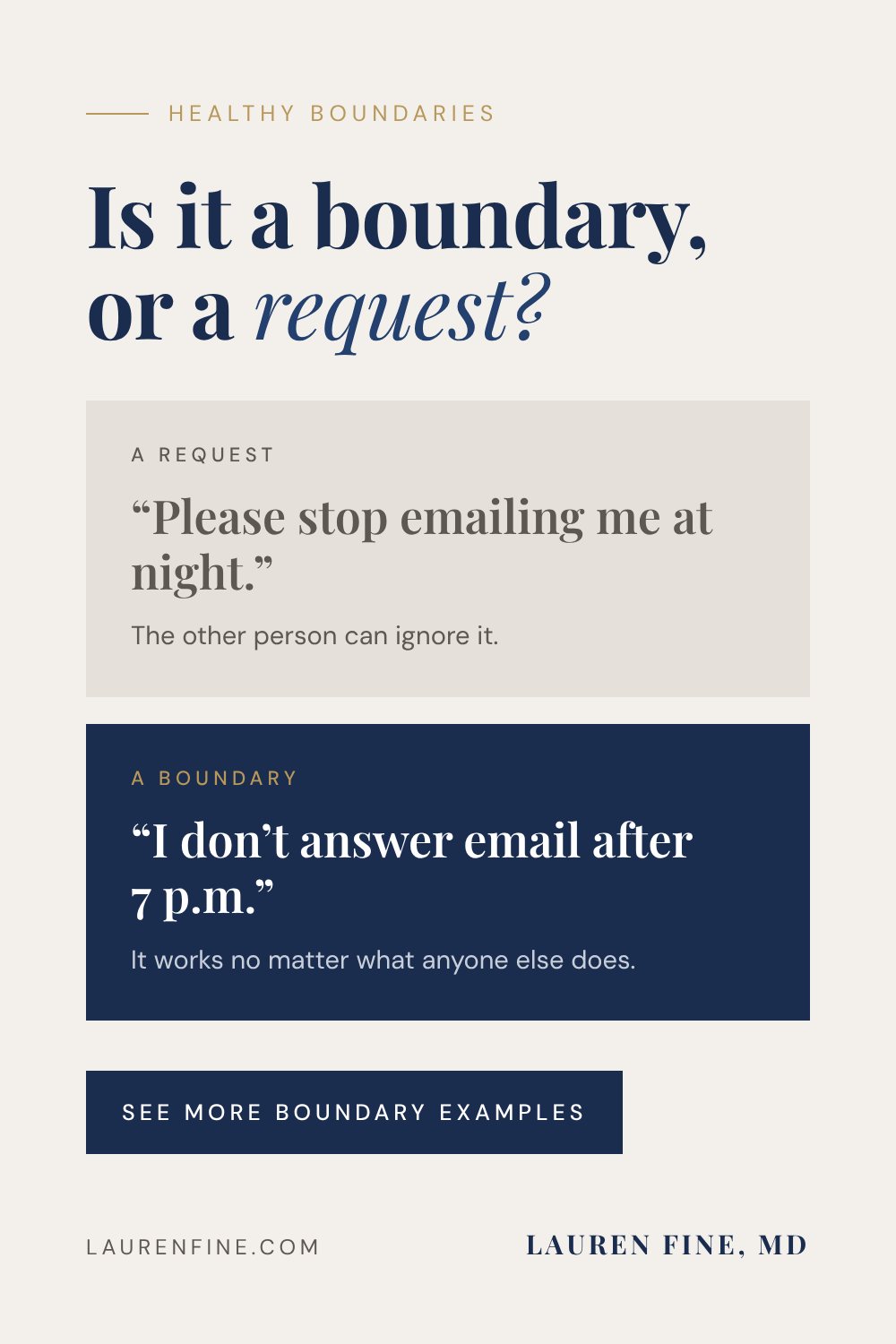
A boundary is a decision about your own behavior. A request asks someone else to change. Requests are fine. Just know which one you are making, because only one of them is in your control.
Which type do you need?
Follow the resentment. Resentment is usually a boundary you have not set yet.
- You resent the hours. Start with a time boundary. See how to set boundaries with your boss.
- You resent the late-night texts. Start with a digital boundary. See work-life balance.
- You resent the venting calls. Start with an emotional boundary. See how to set boundaries with parents.
- You resent the “quick favor.” Start with a material boundary, or learn how to say no.
- You resent carrying the whole household in your head. That is the mental load, and it usually needs a time boundary and a conversation.
Where to start
Pick one type. Pick one boundary. Try it for two weeks. Then notice what you got back.
If you want the words ready before you need them, start with the free Say No Scripts, 12 word-for-word ways to turn something down without burning the bridge. If you want help deciding what to protect first, let’s talk.
Want to go deeper? Here are the best books on boundaries.
Frequently asked questions
What are the 7 types of boundaries?
Physical, emotional, time, mental, material, digital and sexual. Lists vary. Some name three or five types. These seven cover the situations most people run into.
What are 5 examples of healthy boundaries?
Not answering work messages after a set time. Asking for a day before you commit. Leaving a conversation that turns into yelling. Saying no to lending money. Keeping your phone out of the bedroom.
What are time boundaries?
Time boundaries are decisions about how your hours are spent. A meeting-free morning, a protected family dinner, or a rule that you do not take calls after 7 p.m. are all time boundaries.
What are porous boundaries?
Porous boundaries let almost everything through. You say yes to most requests, take on other people’s problems as your own, and share more than you meant to. The usual result is resentment and exhaustion.
What is a lack of boundaries in a relationship?
It often looks like one person always giving in, no privacy, decisions made for you, or feeling responsible for the other person’s mood. Boundaries make a relationship clearer, not colder.
Can you love someone and still have boundaries?
Yes. Boundaries are part of loving someone well. They let you stay in the relationship without resentment.
What kind of person pushes boundaries?
Usually someone who benefited from the old arrangement. Some pushback is normal and fades. Repeated pushing after you have been clear is a signal to follow through with an action, not more explanation.
What is the difference between a boundary and a request?
A request asks someone else to change. A boundary is a decision about what you will do. “Please stop emailing me at night” is a request. “I do not answer email after 7 p.m.” is a boundary.
Keep reading: How to set boundaries, what to do when people don’t respect your boundaries, boundaries with in-laws, boundaries in marriage.