You set the boundary. You said it kindly. You said it clearly. And they did it again.
That is the part nobody prepares you for. Setting a boundary is one conversation. Keeping it is a pattern. This page covers why people push, the signs someone is testing you, what to do the second and third time, and word-for-word scripts for work, family, and your partner. For the basics, start with how to set boundaries with family and at work.
Signs someone is testing your boundaries
- They ask again, slightly differently. Same request, new wrapper. "Just this once." "It's only an hour."
- They go around you. They ask your partner, your colleague, or your kids instead.
- They joke about it. "Oh, she has rules now." Humor makes the boundary look silly so you drop it.
- They wait until you are tired. The ask comes at 9 p.m., on a holiday, or in front of other people.
- They make you explain it again. Every explanation becomes something to negotiate.
- They get louder. Sulking, complaining, or a scene, until someone gives in.
One of these on its own can be an honest mistake. A pattern is a test.
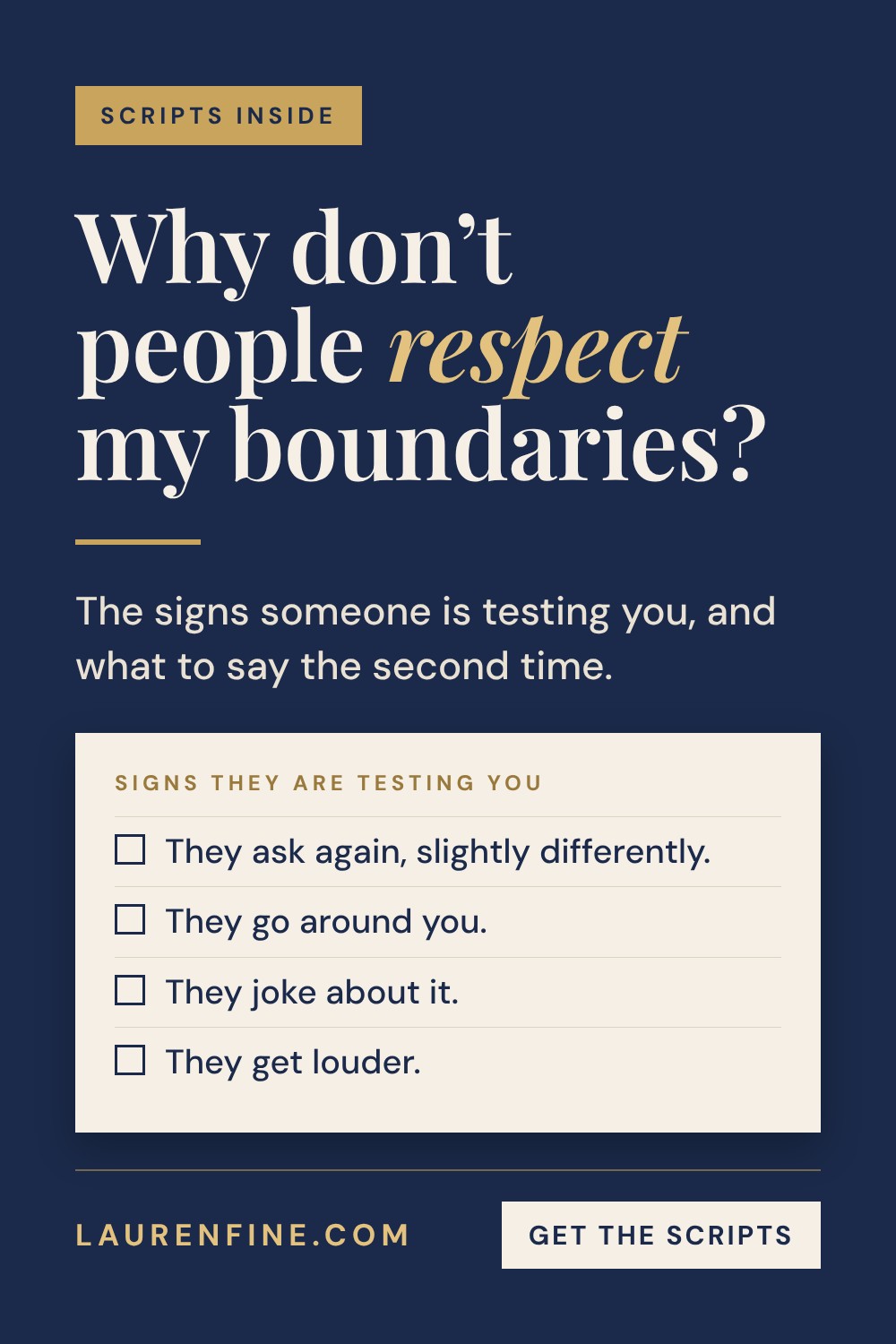
Why don't people respect my boundaries?
Usually it is not because the boundary was wrong. It is because the old arrangement worked for them.
- Giving in has worked before. If pushing got a yes in the past, pushing is a reasonable strategy from their side.
- The boundary costs them something. Time, help, control, or the version of you that always said yes.
- It was stated as a request. "Could you maybe not…" invites a counteroffer. A boundary says what you will do.
- There was no follow-through. If nothing changes when it is crossed, it is a preference, not a boundary.
Expect it to get worse before it gets better
Behavioral psychology calls this an extinction burst. When a tactic that used to work stops working, people push harder before they give up. If you ever sleep trained a baby, you know night two is worse than night one.
This is the moment most boundaries collapse. The pushback spikes, it feels like the boundary is failing, and you give in at the peak. That teaches the hardest lesson of all: push long enough and it works.
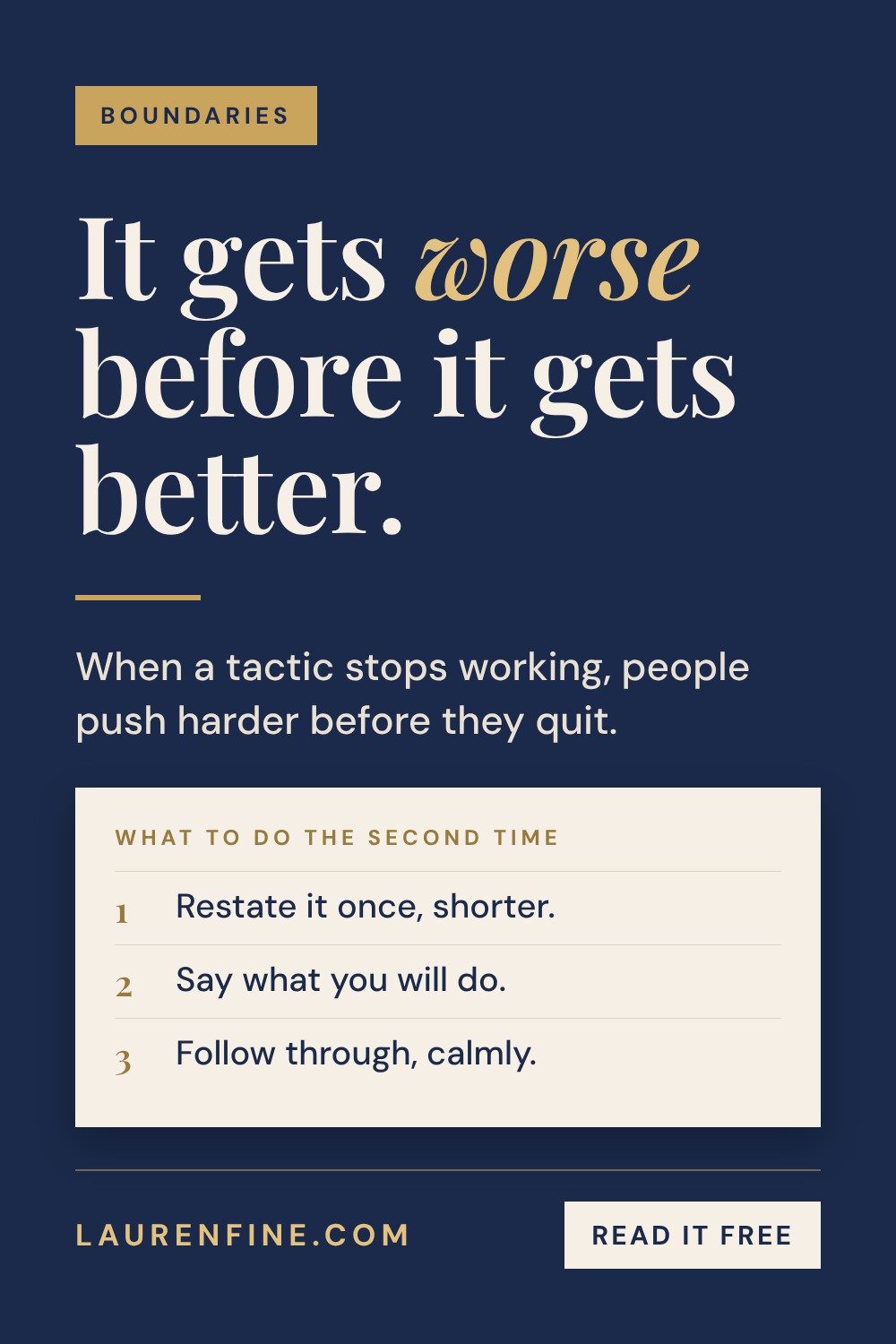
If you expect the spike, you are much less likely to cave at it. I wrote more about this in The Sunday Letter: the person nobody wants to fight.
From Lauren
I stopped allowing people to tell me negative things about other people. I used to just try to ignore it, but that didn’t work because they still felt like they were getting their voice heard.
That behavior has essentially stopped. Sometimes it tries to find its way back, but now that there’s an established boundary and pattern, it doesn’t take much to extinguish it.
Lauren Fine, MD
What to do when someone keeps crossing your boundary
- Decide if this one is worth it. Preferences can go. Values, fairness, and anything that costs your kids or colleagues should not. The free Is This One Worth It? worksheet takes two minutes.
- Restate it once, shorter. The second time needs fewer words, not more. No new reasons.
- Say what you will do. A boundary is about your action, not their behavior. "If it comes up again, I'll leave the table."
- Follow through, calmly. The first follow-through matters more than any conversation. Do what you said, without a speech.
- Talk in private. Ask, "Is this a bad time to talk?" It is harder to say no to than "Is this a good time?" Sit down. Say it face to face, not by text.
- Line up an ally. In a family or a department, everyone waits for someone else to say it. One person on your side changes the room.
- Notice the price. If you give in and still feel fine two days later, it was a good trade. If you are still stewing, you did not save energy. You just moved where you spend it.
Borrowed from negotiation
Hostage negotiator Chris Voss found that people relax when they feel understood, even if you do not give them what they want. Two of his tools help when a boundary is tested.
Label the feeling. Name what you think they feel, starting with “It sounds like” or “It seems like.” “It sounds like you feel shut out when we leave early.” Then restate your boundary. You are acknowledging them, not agreeing to change.
Ask a question that is easy to say no to. “Is this a bad time to talk?” feels safer to answer than “Is this a good time?” People who feel they can say no tend to listen.
Source: Never Split the Difference by former FBI hostage negotiator Chris Voss with Tahl Raz (Harper Business, 2016). More from the Black Swan Group, Voss's company.
From Lauren
Probably have a heart-to-heart with them, explain my perspective and ask theirs. Maybe there’s something that I have missed. Then, once we have had a chance to share our perspective, I reevaluate whether I still have the same opinion before I share anything.
Lauren Fine, MD
Scripts for when your boundary is crossed
At work
- “I can't take that weekend. I've covered the last two holidays.”
- “I answered this on Tuesday. My answer is the same.”
- “I don't check messages after 7. I'll see this first thing tomorrow.”
- “If I take this on, which of my current projects should move?”
With family
- “We're hosting Thanksgiving at our house this year. We'd love to have you.”
- “I've already answered that. I'm not going to discuss it again today.”
- “We're inviting everyone. Hope you'll come.”
- “If this turns into an argument, I'm going to head home, and we can try again another day.”
With your partner
- “When we agree on something and it changes without talking to me, I feel shut out. Can we decide together next time?”
- “I need you to back me up with your mom on this one. Can we agree on what we'll say before Sunday?”
- “I'm not asking you to agree. I'm telling you what I'm going to do.”
With friends
- “I can't make it this time. I'd love to see you next week.”
- “I've told you that joke bothers me. Please stop.”
When it is your husband or partner
Partner boundaries are different. You share a calendar, a house, and often kids. Most of these are not about one person winning. They are about the two of you agreeing on how the house runs.
Start with what you want to protect, not what he did wrong. Pick a calm time. Ask for one specific change, and try it for two weeks. If the boundary is about who carries the planning at home, how to explain the mental load to your husband has a script and a printable explainer.
When it is more than a boundary problem
If someone answers a boundary with threats, intimidation, or anything that makes you feel unsafe, that is not a communication problem. Reach out to a licensed therapist, or contact the National Domestic Violence Hotline at 1-800-799-7233 or thehotline.org. If you are in immediate danger, call 911.
If you keep giving in and do not understand why, that is worth looking at too. How to stop people pleasing goes deeper on that pattern.
Make room
A boundary is not a speech. It is what you do the second time, and the third. Decide which ones are worth it. Say it once, shorter. Expect the spike. Then follow through.
More tools live on the boundaries page. If you want help with a specific person or situation, book a free session. You can also read how coaching works.
Frequently asked questions
What do you do when someone doesn't respect your boundaries?
Restate the boundary once, in fewer words. Say what you will do if it happens again, then follow through calmly. Do not re-explain or argue. Talk in private, and expect the pushback to get worse briefly before it stops.
Why don't people respect my boundaries?
Usually because the old arrangement worked for them, giving in has worked before, or the boundary was stated as a request with no follow-through. It is rarely because the boundary itself was wrong.
What are signs someone is testing your boundaries?
They ask again in a slightly different way, go around you to someone else, joke about your boundary, wait until you are tired or in public to ask, make you explain it again, or get louder until someone gives in.
Why does it get worse after I set a boundary?
When a tactic that used to work stops working, people often push harder before they give up. Psychologists call this an extinction burst. If you hold steady through the spike, it usually fades.
What if my husband doesn't respect my boundaries?
Pick a calm time, start with what you want to protect, and ask for one specific change to try for two weeks. If it is about who carries the household planning, a written list of the mental load helps. If you feel unsafe, contact a licensed therapist or the National Domestic Violence Hotline.